
Family Law Education Network

Category: FLENA Blogs

Cracking Complex Property Pools: Trusts What Every Family Lawyer Must Understand Before Advising or Drafting Orders

Trusts are one of the most challenging asset types in family law property matters. Whether it’s a family discretionary trust, a hybrid unit trust, a corporate structure wrapped inside a trust, or an SMSF holding trust assets, practitioners must understand how a trust operates before advising clients or attempting to draft Orders that deal with trust property. This guide breaks down the essentials every lawyer must master.

| Read More

Forensic Evidence in Family Law: When to Call in the Experts

Family law matters often turn on more than what parties say. They turn on what can be proven. In an era where financial structures are complex, parenting disputes are increasingly nuanced, and digital footprints form part of the evidentiary landscape, forensic evidence has become an essential tool for modern family lawyers.

| Read More

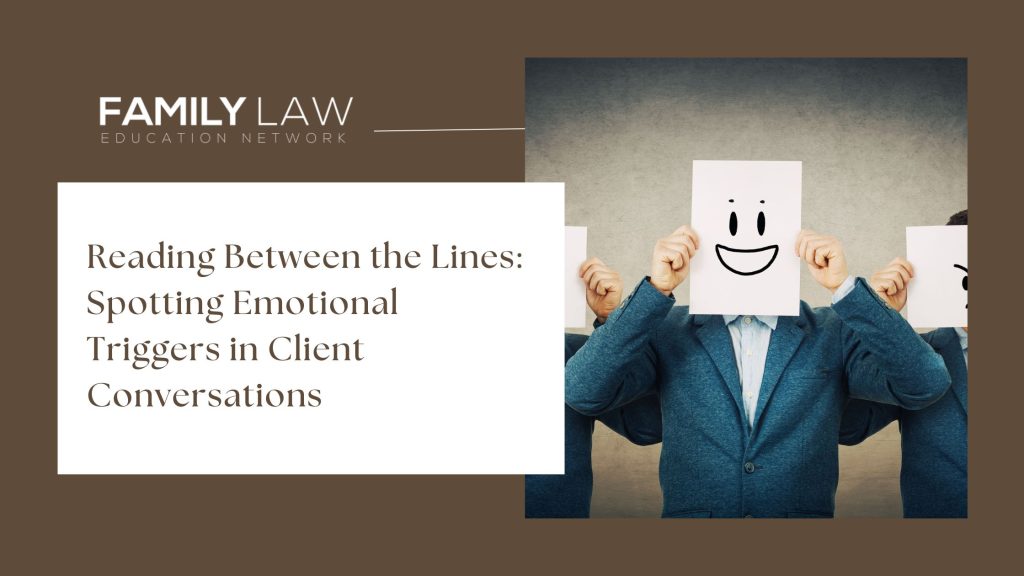
Reading Between the Lines: Spotting Emotional Triggers in Client Conversations

Family law clients rarely speak in straight lines. Their words are shaped by fear, grief, anger, shame, confusion, or exhaustion — and often all at once. As practitioners, our job is not only to listen to what clients say, but to understand what sits underneath what they say. The ability to spot emotional triggers early is one of the most valuable skills a family lawyer can develop. It informs strategy, improves rapport, reduces conflict, and ultimately leads to better outcomes for clients and matters alike.

| Read More

Why Words Matter: Communicating with Clients in Conflict

In family law, words are not just information — they are tools that shape trust, influence decision-making, and either calm or escalate an already fragile situation. For clients in conflict, language has even greater power. It can anchor them, empower them, or overwhelm them.

| Read More

Avoiding the ‘Reactive Lawyer Trap’ — Staying Strategic Under Pressure

In family law, pressure is constant.
Clients are distressed, deadlines are tight, evidence is incomplete, and conflict escalates with little warning.
Under these conditions, even seasoned practitioners can slip into what many call the Reactive Lawyer Trap — the cycle of responding, firefighting, and reacting to the loudest or most urgent problem of the day.

| Read More

Building Smarter Case Strategies: Where Good Family Law Matters Begin

Every strong family law matter begins long before the first affidavit is drafted, the first subpoena is issued, or the first mention date arrives. It starts with strategy, but not strategy in the abstract, theoretical sense. Effective family law strategy is structured, evidence-driven, child-focused, and grounded in a clear understanding of risk, resources, and outcomes.

| Read More

Setting Boundaries as a Lawyer: Protect Your Time, Energy, and Well-Being

Lawyers are known for their dedication, long hours, and unwavering commitment to their clients. However, without proper boundaries, the profession can quickly become overwhelming, leading to stress, burnout, and decreased job satisfaction. Setting and maintaining healthy boundaries is essential for a sustainable legal career. Here’s how lawyers can implement practical strategies to protect their time, energy, and well-being.

| Read More

Cracking Complex Property Pools: Trusts What Every Family Lawyer Must Understand Before Advising or Drafting Orders

Trusts are one of the most challenging asset types in family law property matters. Whether it’s a family discretionary trust, a hybrid unit trust, a corporate structure wrapped inside a trust, or an SMSF holding trust assets, practitioners must understand how a trust operates before advising clients or attempting to draft Orders that deal with trust property. This guide breaks down the essentials every lawyer must master.

| Read More

Forensic Evidence in Family Law: When to Call in the Experts

Family law matters often turn on more than what parties say. They turn on what can be proven. In an era where financial structures are complex, parenting disputes are increasingly nuanced, and digital footprints form part of the evidentiary landscape, forensic evidence has become an essential tool for modern family lawyers.

| Read More

Reading Between the Lines: Spotting Emotional Triggers in Client Conversations

Family law clients rarely speak in straight lines. Their words are shaped by fear, grief, anger, shame, confusion, or exhaustion — and often all at once. As practitioners, our job is not only to listen to what clients say, but to understand what sits underneath what they say. The ability to spot emotional triggers early is one of the most valuable skills a family lawyer can develop. It informs strategy, improves rapport, reduces conflict, and ultimately leads to better outcomes for clients and matters alike.

| Read More

Why Words Matter: Communicating with Clients in Conflict

In family law, words are not just information — they are tools that shape trust, influence decision-making, and either calm or escalate an already fragile situation. For clients in conflict, language has even greater power. It can anchor them, empower them, or overwhelm them.

| Read More

Avoiding the ‘Reactive Lawyer Trap’ — Staying Strategic Under Pressure

In family law, pressure is constant.
Clients are distressed, deadlines are tight, evidence is incomplete, and conflict escalates with little warning.
Under these conditions, even seasoned practitioners can slip into what many call the Reactive Lawyer Trap — the cycle of responding, firefighting, and reacting to the loudest or most urgent problem of the day.

| Read More

Building Smarter Case Strategies: Where Good Family Law Matters Begin

Every strong family law matter begins long before the first affidavit is drafted, the first subpoena is issued, or the first mention date arrives. It starts with strategy, but not strategy in the abstract, theoretical sense. Effective family law strategy is structured, evidence-driven, child-focused, and grounded in a clear understanding of risk, resources, and outcomes.

| Read More

Setting Boundaries as a Lawyer: Protect Your Time, Energy, and Well-Being

Lawyers are known for their dedication, long hours, and unwavering commitment to their clients. However, without proper boundaries, the profession can quickly become overwhelming, leading to stress, burnout, and decreased job satisfaction. Setting and maintaining healthy boundaries is essential for a sustainable legal career. Here’s how lawyers can implement practical strategies to protect their time, energy, and well-being.

| Read More