
The Strategy Spine is designed not only to improve matter outcomes, but to reduce the cognitive burden of legal practice. When Assess organises information strategically, Explore tests pathways before they create problems, and when Engage and Resolve provide structured environments for execution and closure, practitioners spend less time firefighting and more time thinking clearly. That reduction in cognitive load is one of the central purposes of the Spine, and it is why switching off becomes possible only when the framework is working as it should.
Every December, the same pattern repeats itself.
Matters that have dragged on all year suddenly become “urgent”. Clients email at 11.47pm with “just one more question”. Courts list long-awaited events for the week before shutdown. Staff get sick, school concerts multiply, and somewhere in there we’re supposed to be “festive” and “rested”.
Most family lawyers go into the break exhausted and come back still tired, because they never really switched off — they just moved their laptop from the office to the dining table.
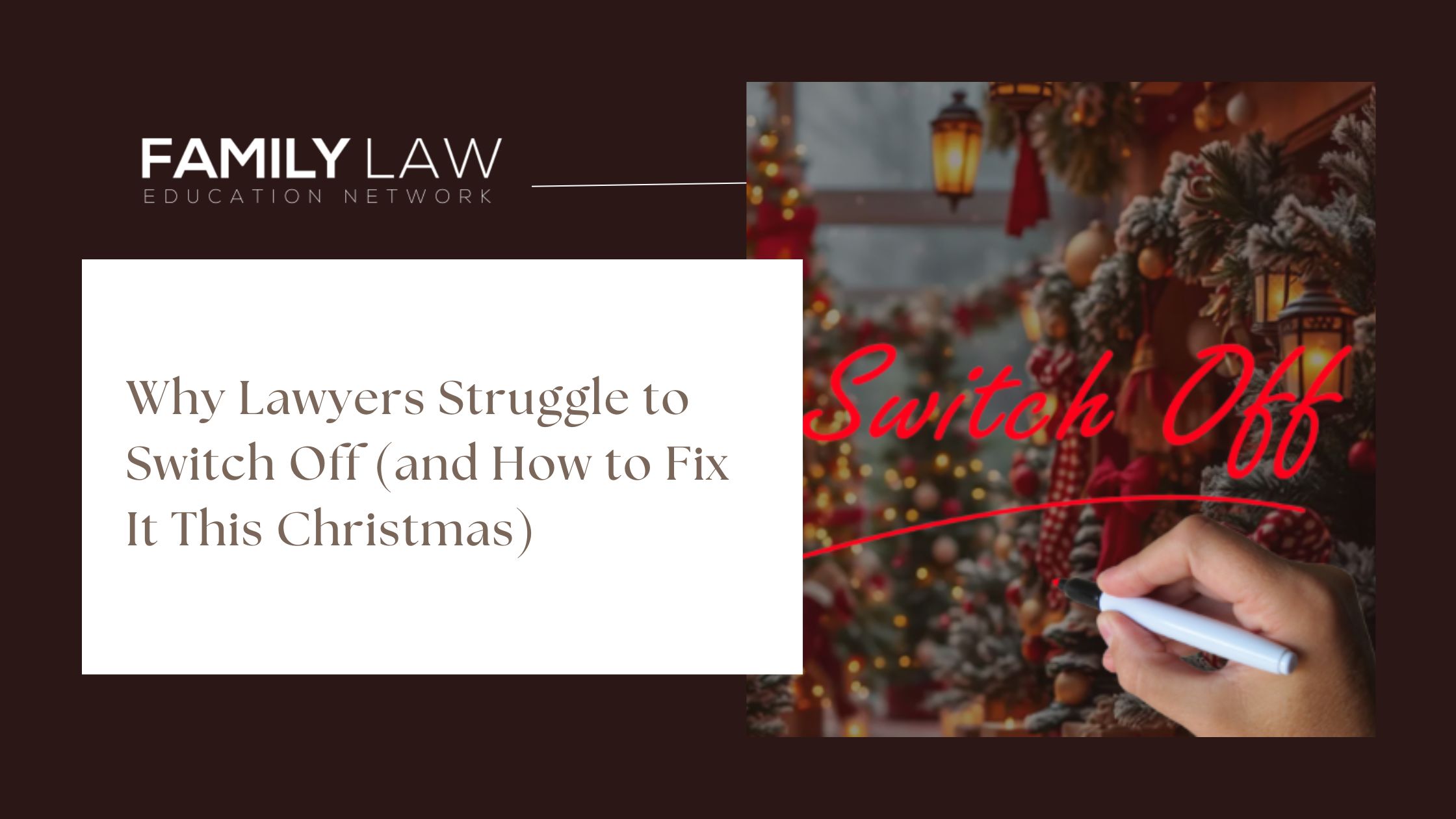
So why is it so hard for us to disconnect, and what can we practically do about it this Christmas?
Why switching off feels impossible
For family lawyers, it’s rarely just “bad time management”. A few deeper dynamics are usually in play:1. We carry other people’s crises in our bodies
We listen to trauma all year: family violence, financial stress, children caught in the middle. Even when we go home, our nervous system is still braced for the next email, call, subpoena or allegation. Rest feels unsafe because our body has forgotten what “not on alert” feels like.2. Our identity is tied to being “the one who fixes things”
Many of us became family lawyers because we’re helpers, problem-solvers, advocates. We’re used to being the person who steps in, holds the line and finds a way through. Saying, “I’m not available over Christmas” can feel like abandoning people — even when we rationally know there are boundaries and systems in place.3. The profession quietly rewards overwork
We still operate in cultures where the “safe” lawyer is the one who responds fastest, bills the most and never drops a ball. Even if our firm talks about wellbeing, the unspoken message can be: “Real commitment means always being on.” Switching off feels like a risk to reputation, income or progression.4. Technology makes everything urgent
Emails on phones, Teams/Slack notifications, client messages on every platform. There’s no natural “office door” anymore. If we don’t build a door, there isn’t one.5. Guilt — especially around vulnerable clients
It’s hard to rest when you know a client is living with risk, poverty or constant conflict. We tell ourselves, “I’ll just check in,” then two hours and six emails later, our brain is back at work. Recognising these patterns is not about shame; it’s about understanding the forces we’re working against so we can consciously do something different.Designing a Christmas where you actually switch off
You can’t control every crisis. But you can design a break that gives your nervous system a fighting chance. Here are some practical, lawyer-proof strategies you can start now.1. Plan your “acceptable availability” in advance
Instead of vaguely promising yourself “I’ll try to rest”, decide deliberately:- Which dates you are truly unavailable
- Whether there are limited times you will check emails (for example, a 30-minute window every 2–3 days, or not at all)
- Who in the firm is covering which categories of urgency (DV/safety issues, court deadlines, new enquiries)
2. Prepare your clients before everyone melts down
In early December, send a calm and clear communication to active clients explaining:- Office closure dates
- How genuinely urgent matters (e.g. immediate safety risk, court orders) will be handled
- What counts as “urgent” and what can wait
- What they can reasonably expect during the break
3. Create a “soft landing plan” for yourself
Your nervous system won’t go from 110% to peaceful just because the calendar says 24 December. Think about:- The first 48 hours of your break: can you avoid social overwhelm and allow some decompression time?
- One or two daily anchors (a walk, swimming, reading, time with kids) that have nothing to do with law
- Simple rituals to signal “work is off now” — closing the laptop and putting it away, turning off email notifications, physically leaving your home office
4. Use your values, not your guilt, as a guide
If you’re struggling with the idea of not being constantly available, ask:- What kind of lawyer — and human — do I want to be in 5–10 years?
- What do my kids/partner/friends need from me this Christmas?
- What does future-me need to avoid burnout or leaving the profession entirely?
5. Make it a team culture, not a solo rebellion
Switching off is easier if you’re not the only one trying. Within your firm or team, you might:- Agree on shared closure protocols and “no email” expectations
- Rotate a very small, well-supported on-call roster if absolutely necessary
- Debrief early December about what each person finds hardest about taking a break, and problem-solve together
A Quick “Switching Off” Check for Lawyers This Christmas
- ☐ Have I clearly decided when I am actually off, and communicated it?
- ☐ Do my clients know what’s urgent, what’s not, and who handles what over the break?
- ☐ Have I turned off work notifications from my phone (or at least limited them)?
- ☐ Have I planned a few simple rituals that signal “I am not at work right now”?
- ☐ Am I choosing my boundaries based on my values, not my guilt?